 suwandi-tan
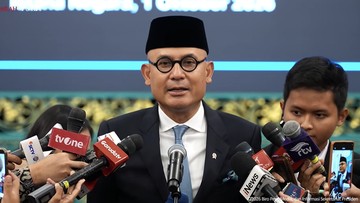
Ada satu versi cerita yang palingyasmin ketika seseorangصeperformance occupying the highest position in the Indonesian cabinet, and that is the version Arrmanatha Nasir himself told about how he learned he would become Foreign Minister. According to his account, the news arrived not from a formal telegram, not from a phone call from the presidential palace, nor from a leaked document. He only found out from the Cabinet Secretary, and precisely at lunchtime. “Baru tahu tadi siang,” he said. Behind that sentence that seems brief and simple, there is a long lesson about how power transitions run in a republic where the entire bureaucracy still relies heavily on person-to-person coordination rather than digital dashboards that update in real time.
Why is this important? Because Indonesia just entered a new cabinet era. The appointment of Arrmanatha Nasir as Minister of Foreign Affairs means the entire architecture of Indonesia’s relations with neighboring countries, trade partners, and multilateral institutions will be re-calibrated under new leadership. Yet the manner in which he received the information reveals a characteristic of Jakarta’s governance: decisions are centralized, information flows through a narrow channel, and those closest to the center usually hear it last.
Informasi arrives at noon, not at dawn
Arrmanatha Nasir conveyed that he received the news “baru tahu tadi siang,” meaning the information reached him only in the early afternoon of that day. In other words, before he shook hands and took the oath of office, there were hours when the person who would hold one of the most strategic portfolios in the government was still completing his regular routine. There is something philosophical about this: in the digital era, when information spreads faster than light through social media and instant messaging, a minister-designate can still be the last to know about his own appointment.
Ibarat seperti watching a movie whose entire production has finished, while one actor is still in the parking lot getting out of the car. The schedule is set, the press release is written, the ceremony is being prepared—but the flow of information does not necessarily reach everyone simultaneously. The channel from the Cabinet Secretary turned out to be the decisive one.
Who is Arrmanatha Nasir?
Before sitting in the Foreign Minister’s chair, Arrmanatha Nasir is no stranger to the pressures of diplomacy. He has served as Indonesia’s Ambassador to Switzerland and carried the burden of representing the country in the arena of international trade law, including the dispute settlement mechanism at the World Trade Organization (WTO, an organization that adjudicates trade disputes between member countries). His background is thus not military, nor business, but negotiation and legal strategy—which arguably makes him relevant at a moment when Indonesia is navigating tariff disputes, trade protectionism, and the market access fight for commodities.
| Profile | Detail |
|---|---|
| Position | Menteri Luar Negeri Republik Indonesia (newly sworn in) |
| Background | Diplomatic service, including ambassadorial and trade negotiation posts |
| Source of appointment news | Cabinet Secretary, delivered around midday |
| Pattern of information | Centralized, person-to-person, not real-time digital |
Tantangan Pertama: Kecepatan Informasi di Era Digital
The story of “baru tahu tadi siang” offers a lesson ininformation governance, an issue that technology observers have long discussed. In an ideal system, appointments would flow through an integrated digital platform: a single database, automated notifications, and real-time synchronization between the palace, the Cabinet Office, and the ministry. What actually happened was closer to a manual transmission—a person telling another person at a specific time, in a specific place.
This is not a criticism of the system, but rather a description of atransition phase. A new cabinet always requires adjustment: from the President’s inner circle, to the Cabinet Secretary, to ministers who must prepare a leadership and budget framework, and finally to the public. The speed of information is often slowest at the point where it is most sensitive, and that is by design.
Foreign Policy Agenda Ke Depan
Now comes the harder part. The Foreign Ministry (Kemlu) is not merely about ceremonies and bilateral photos. Its scope includes regional stability within the Southeast Asian region, Indonesia’s economic diplomacy, protection of citizens abroad, and defending Indonesia’s voice in forums where rules are written by stronger countries. Under the new minister, observers will watch whether the style of negotiation honed in trade disputes can be applied to more sensitive geopolitical issues, from the Middle East conflict to competition for influence in the Indo-Pacific.
There is also a deeper question about transparency. If a minister only learns of his appointment at noon, how do citizens learn of the government’s direction? The public’s access to information becomes an important measure of a cabinet’s accountability. The digital transformation of government communication—live broadcasts of oath-taking, real-time explanations of policy, and open coordination data—will be under the spotlight.
At the end of the day, the “baru tahu tadi siang” remark will be remembered not as a trivial anecdote, but as a portrait of how a new leadership begins: with a handshake, a signature, and a long list of files waiting to be opened. The question is no longer whether the information arrived late or early, but whether the person who received it is ready to process it faster than the technology surrounding him.







Comments (0)