 grace-winata
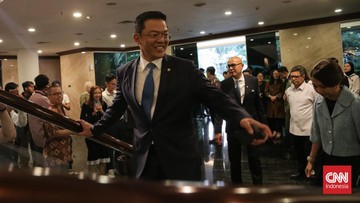
seldom occurs in Indonesian bureaucracy that a single family gathering carries two meanings at once. That is what unfolded at the Ministry of Foreign Affairs, where a large circle of officials both welcomed a returning leadership figure and bade farewell to another name that has long been part of the institution's daily rhythm.
Ministry of Foreign Affairs (Kementerian Luar Negeri) is the cabinet ministry in charge of Indonesia's relations with other countries. It is an institution built on ceremony, protocol, and hierarchy, yet it is also famous within its own walls for a surprisingly warm, family-like atmosphere. And it is precisely that atmosphere that became visible in a scene combining a formal welcome with an improvised farewell concert.
The farewell moment drew the most attention. Before departing, Sugiono was accompanied by his colleagues as they sang together to the tune of “Kamu Ngga Sendirian,” a popular ballad built around one simple promise: nobody faces the hardest days alone. For a bureaucrat who has spent years navigating state-to-state negotiations, aid coordination, and consular cases, hearing that refrain from the very institution he served is arguably worth more than any farewell handshake.
The gesture was not a grand state ceremony. It was colleagues, standing shoulder to shoulder, turning an ordinary working relationship into a memory.
Why Leadership Transitions Matter Beyond the Ministry
Changes at the top of the foreign ministry ripple outward well beyond the building itself. A minister does not only shake hands; they shape Indonesia's tone in multilateral forums, the wording of official statements, and the confidence with which the country presents its position on regional security, trade, climate, and people-to-people exchanges.
Technicians often describe this as “policy continuity versus renewal.” Continuity keeps long-running negotiations on track — from ASEAN (Association of Southeast Asian Nations / laborious Perhimpunan Negara-Negara Asia Tenggara) coherence to bilateral investment protection. Renewal, meanwhile, injects new energy and, crucially, signals to dozens of embassies and consulates abroad that priorities may be recalibrated.
| Aspek | Efek bagi(bytes) publik |
|---|---|
| Serah terima jabatan | Memblokir atau memperlambat proses keputusan di forum multilateral |
| Suara dalam diplomasi | Pesan diplomatik ke negara mitra perlu dibaca ulang |
| Relasi dengan diaspora | Program consular services (layanan konsuler) bisa Yes Yes YesYes YesYes Yes Yes YesYes Yes Yes |
More than anything, transitions inside the Kemlu family are a test of institutional memory. Ministry officials describe the learning curve at embassies as steep: files must be understood, not merely received.
Why a Song Is a Serious Diplomatic Instrument
It is easy to dismiss a group sing-along as mere sentiment. Yet in bureaucratic culture, singing serves a genuine function. It marks belonging. Joining a refrain requires lowering the voice guard for a moment, turning colleagues into a single audience, and acknowledging that shared work produces shared memory.
In that sense, the farewell gathering functioned as a piece of non-verbal documentation. No minutes recorded it, no press release quoted it, and yet for everyone present it encoded a message: this person is leaving, and the contribution was noticed.
Meanwhile, the arrival of Arrmanatha Nasir carried the opposing weight. Coming back into the fold after time elsewhere in government, a leader inherits both authority and expectation. What they hear in that room — whether applause, jokes, or a familiar song — frames how the institution will read their first months in office.
One Event, Two Emotional Directions
Combine both moments and the picture becomes richer. A farewell and a welcome occurring in the same breath is a natural reflection of how governments work: every arrival is somebody else's departure, and every transition is a rearrangement rather than a reset.
For the broader public, the significance is symbolic. Diplomats may appear distant in press conferences, but they are also ordinary workers — people who draft notes, chase signatures, and occasionally end a long chapter with a chorus of a favourite ballad. Making that humanity visible is a small but real contribution to public trust in state institutions.
The message embedded in the song title itself is neither grand nor partisan. It simply asks one question: after the applause fades, who is still standing beside you? Inside a ministry responsible for representing a nation of more than 270 million people to the world, that question carries a particular resonance.









Comments (0)