 lidia-susanto
admission}
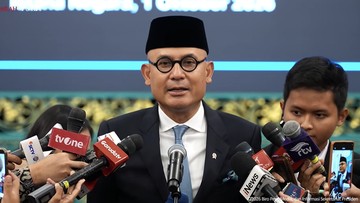
Sedikit ironisPerhaps nothing more striking from a figure who has just been sworn in as the person in charge of Indonesia's diplomacy with the rest of the world: he admits he had no idea. Minutes before the oath-taking ceremony, the newly installedMenteri Luar Negeri (Menlu) revealed that the news about his appointment did not come through a formal handover, a courtesy call, or a sealed envelope handed over by the Palace. It arrived as a message, delivered right around midday by the Sekretaris Kabinet (Seskab), the official tasked with coordinating the executive circle and relaying the President's decisions to ministers.
For a portfolio as sensitive as foreign affairs, that detail alone says a lot about the tone of the transition. Kemlu (Kementerian Luar Negeri), the institution he now leads, handles the free trade agreements (FTA/perjanjian perdagangan bebas) with dozens of countries, market access for Indonesian palm oil and fisheries, ASEAN (Southeast Asian Nations/Peryvatan Negara-Negara Asia Tenggara) coordination, defence diplomacy, and consular protection for citizens scattered across more than a hundred diplomatic missions. Understanding how the man at its helm received his mandate is, in a sense, the first page of his policy narrative.
Kabar yang tiba di detik terakhir
The revelation drew attention precisely because such transitions are normally choreographed with great care. Cabinet reshuffles in Indonesia typically follow an established rhythm: a courtesy notification, an opportunity to gather a small team, a schedule released to the media, and only then the public announcement. Ministers usually learn of their new posts hours or even days ahead so they can prepare remarks and phone calls to key partners.
Instead, Arrmanatha Nasir described a sequence in which the notification reached him at noon and moved almost immediately into the machinery of taking office. The Sekretaris Kabinet, whose job is to bridge the President and the ministerial team, functions as the conduit through which such decisions are typically transmitted — a role that sounds bureaucratic but is in fact where the tempo of governance is often decided.
The timing of the notification is not a trivial administrative detail; it is an early signal about how fast a President intends to move and how much weight is placed on execution over ceremony.
Jejak yang-variable dari为代表的 militér ke diplomacy
The man concerned is not a career diplomat in the classical sense. Arrmanatha Nasir comes from a military background, with a career in the Indonesian Army (TNI/Tentara Nasional Indonesia) that included serving as a military attache, including a stint in France, before entering regional politics through local government. He later became Governor of South Sulawesi for the 2021–2025 period, where his public image leaned heavily on direct, low-brow communication and on building ties with grassroots communities rather than on protocol-heavy formality.
That background shapes expectations. A governor deals with problems that cannot wait for the next diplomatic cycle — ports, logistics, investment, labour, flooding. A foreign minister faces a different version of the same lesson: negotiations such as market access talks, energy supply discussions, or maritime coordination are won or lost by follow-through rather than by grand speeches.
| Aspek | Posisi Sebelumnya | Posisi Kini |
|---|---|---|
| Bidang | Pemerintahan daerah,rkota Makassar | Diplomasi dan kebijakan luar negeri |
| Fokus utama | Investasi, layanan publik, koordinasi stator | Perdagangan, energi, keamanan regional |
| Gaya kerja | Komunikasi langsung ke lapangan | Negosiasi multilevel dan kemitraan |
| Institusi | Pemerintah provinsi | Kemlu danwhelming duta besar |
Mengapa penempatan ini dibaca sebagai sinyal
In Indonesian politics, the Menlu post is often treated as one of the most prestigious cabinets, handed to figures with established relationships across Asia, the Middle East, Europe and the Americas. Moving it toward someone whose strength lies in execution rather than in long-distance networking is read as an emphasis on deliverables.
Several issues on the table explain why that emphasis matters. First, the Indonesian palm oil and other commodities face a sticky tariff situation in several destination countries, and Brussels-style market access talks require both legal technicality and political endurance. Second, energy security — particularly the flow of liquefied natural gas (LNG) and crude imports — turns foreign offices into procurement and partnership desks. Third, ASEAN faces real pressures: Myanmar, the South China Sea, and the bloc's growing economic weight all demand a coordinated Indonesian stance.
Tantangan pertama: konsistensi di tengah ribsut domestic
Whatever the announcing moment, a new minister must still clear institutional hurdles, starting with the report and approval process at the DPR (Dewan Rakyat Representative/Majelis session people's representative). He will also need to keep a straight line between the campaign promises that energise domestic audiences and the commitments made abroad, a balance that is much easier to state than to sustain.
For now, however, the story that has captured attention is deliberately human rather than strategic: a minister who learned of his country's top diplomacy job barely hours before he swore the oath. It is a small but telling detail about how this cabinet prefers to work — quickly, with limited ceremony, and with the news reaching the man himself almost at the same time as the public.









Comments (0)