 grace-winata
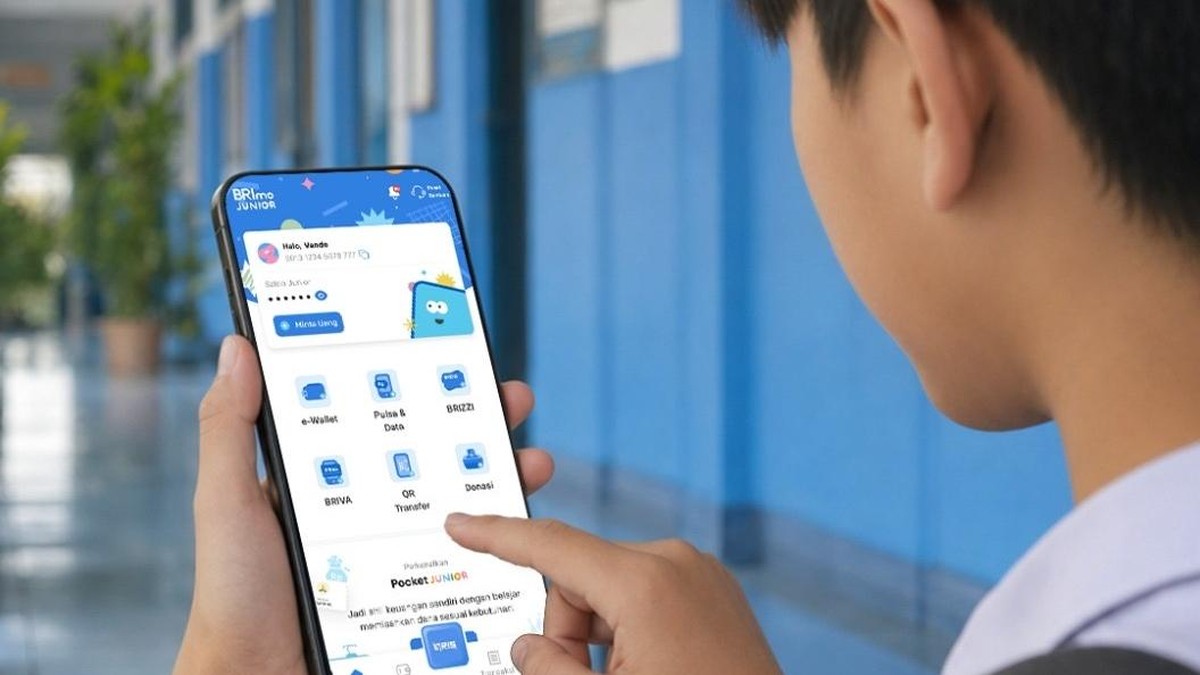
Bayangkan seberapa banyak anak sekolah yang masih其次一时间 bertanya, "Uang jajan妈, aku dapat dari mana?" permeate penggalian imajinasi. Sitting room—that's the reality in many Indonesian households today: children aged 7 to 12 years old already hold smartphones, often more fluent in navigating applications than their parents, yet have zero understanding of how money actually circulates. Di sinilahLaunch_BRIMO Junior-that is, the presence of a feature specifically designed for children and teenagers up to 17 years old—carries weight far beyond the category of "new banking feature." This is an attempt to move financial education (literasi keuangan) from classroom theory into the daily routine of a generation that is growing up surrounded by digital transactions.
From an Adult's Wallet to a Child's Account
The presence of banking services for minors is not a completely new idea. Several banks and fintech companies have experimented with teen accounts (rekening Teens) or pocket-money (uang saku) features. However, most implementations stop at the physical card or top-up limits (batas pengisian). The strategy taken by BRIMO Junior is slightly different: it places the main control panel in the mobile banking application that parents already use every day, the BRIMO application.
In practical terms, children under 17 years old obtain access not as independent account holders, but through accounts linked to a parent's account. Every transaction executed in the child's account remains within the parent's radar. This resembles a "training wheels" model—analogically like a child riding a bicycle first being given training wheels, being allowed to pedal and steer on their own, before eventually being "released" to ride without assistance when they're ready.
Why Age17 Matters
The figure of 17 years old is a deliberate choice. In Indonesia, the legal age for independent financial transactions and the possession of an electronic money account (rekening uang elektronik) generally starts from the age of 17 years. That means, at 17, a person can already open a bank account on their own, apply for a debit card, and access various digital banking services.
The critical transition period is exactly between elementary school and high school, when spending habits begin to form and peer influence is enormous. A survey by Bank Indonesia (BI) as the central bank repeatedly shows that financial literacy (literasi keuangan) scores among the younger generation remain far below the ideal. Against that backdrop, closing the gap one year earlier becomes an educational strategy disguised as a product feature.
Features: Small Nails, Large Meaning
Inside BRIMO Junior, the main features revolve around three things. First, transaction limits according to age. Younger children receive smaller ceilings—logically, a7-year-old certainly shouldn't be able to spend tens of thousands of rupiah in one go. This is not just a security feature, but also a tool for learning, namely introducing the concept of budgeting (anggaran).
Second, parental monitoring (pendampingan orang tua). Parents can see incoming and outgoing transaction records in real time (waktu nyata), set daily or weekly limits, and receive notifications (notifikasi) every time the child makes a purchase. Without these notifications, digital money becomes an invisible consumption, and parents lose the ability to have conversations like "why did you buy that candy?"
Third, saving goals (tabungan). Some applications of this kind allow children to set themselves a target amount—for example, for a bicycle, a game, or school fees—and parents can give them "coins" automatically. This is a simple mechanism, yet psychologically strong: children learn that money isn't just for spending, but also for pursuing a goal.
"If parents only give pocket money without discussing where the money came from and where it went, the child only learns to consume, not to manage. Digital features are actually opening a new window of conversation that previously rarely happened—because now, every expenditure is recorded and visible." — gulf financial education practitioner
Ecosystem and Disruption: Not Just a Feature Competition
This launch places BRIMO within a broader ecosystem (ecosystem) battle that is currently heating up. Digital wallets (dompet digital) and mobile banking (mobile banking) are no longer competing on features alone, but on how deep they embed themselves into users' daily habits. Financial technology (fintech) companies and banks alike realize that whoever wins the hearts of mothers and children today wins a loyal customer for the next 15 years.
There is also efficiency value for the banks themselves. The presence of children as users means an increase in the number of active accounts, transaction frequency, and cross-selling opportunities when they later become teenagers. This is a classic case of "customer lifetime value"—building a relationship early on.
Of course, skepticism remains fair. Some parents will ask: isn't giving a smartphone to a 7-year-old too early? Isn't this training children to consume? The counter-argument is simple: children are already exposed to payment through QRIS (Quick Response Code Indonesian Standard) at school canteens, through online game top-ups, and through advertisements on social media. Denying access entirely doesn't remove consumption behavior—it only removes parental visibility.
The Real Test: Conversations That Accompany the Feature
Ultimately, no digital feature can replace the role of parents as financial educators. BRIMO Junior is nothing more than a recording device and a boundary-setter. What matters is whether a mother or father, after seeing the child's purchase notification, actually opens a dialogue about needs versus wants (kebutuhan versus keinginan).
Still, in a digital era where everything is being measured by transactions, providing a safe space for children to "practice" spending is arguably better than letting them practice alone without guidance. After all, financial literacy (literasi keuangan) isn't only about knowing the interest rate, but also about understanding the value of a single packet of snacks—and the dozens of sacrifices behind it.












Comments (0)